
Mogging Joyce Carol Oates
In which Andrew Tate and Clavicular expose the energy crisis at the center of literary culture

A BISEXUAL CYBER MONK country musician from a singlewide trailer was telling an anonymous fascist to “fuck off with bells on” in my comments section and the fascist was posting the guy’s Facebook photos and calling him inbred and I was watching this happen to an essay I’d spent two weeks writing about ART.
I published my first piece fourteen days ago — Right-Wing Art Doesn’t Exist — it did well. Five hundred people liked it, which means I had roughly the same readership Moby Dick enjoyed during Melville’s lifetime, except Melville didn’t have to watch a stranger with a Confederate flag avatar tell him his prose style indicated a history of childhood molestation.
A commenter told me “this is a lot of writing for someone who obviously doesn’t read” and I said “Thank you,” another one called me a communist sexual deviant and I said “Thanks for reading,” I was in the ring, blood on my teeth, I felt like Joyce Carol Oates, and then I saw a viral video of Andrew Tate declaring his brain too advanced for books — hundreds of thousands of views, probably millions — and the feeling went away.
Not because he was right.
Because that glistening ape had ten million people hanging on every grunt and I had five hundred.
"Reading books is a very cheap way to entertain—I wouldn't call it entertainment because my brain is far too advanced. I'm too smart to read. I need action. I need constant chaos in my life to feel content. I need to be driving a supercar and fucking FIGHTING—I can't just sit there and go 'oh, oh and the pirate on the boat'—that's for people with slow brains."
I watched the video three consecutive times. Then I watched his response.
“I’m too smart for books. There’s always some broke dude who reads books who’s upset by the fact that I have a 110 million dollar car collection. I get asked on every podcast about every subject—pussy, bitches, geo-politics, money, you name it—every single podcaster begging me, PLEASE will you come on my show, PLEASE with your opinions. I learn all my lessons through action, through fighting, I win some fights, I lose some fights, but at least I get in there and FIGHT—you’re fucking READING, I’m a man of action, you’re a man of fucking pages, and if reading’s so important how come nobody knows who the FUCK you are?”
Then I did something I cannot fully explain — I transcribed both videos by hand. Each. Individual. Word. A man telling me that reading is beneath him and I was copying his words down like scripture. Hunter S. Thompson used to type out The Great Gatsby and A Farewell to Arms word for word on his own typewriter just to feel the prose moving through his hands, to absorb the rhythms through his fingers… was I doing the same thing with Andrew Tate?
I don’t know.
But somewhere around the fourth transcription the flagellating nonsense started to change shape and I heard it — the cadence, the build, the way he holds a room the way a sentence is supposed to hold a reader — it wasn’t rhetoric anymore, it was almost an incantation, and the thing that kept me up at 4 AM wasn’t that he was wrong — he IS wrong ; — it was that he was WINNING, that millions of people didn’t need to be convinced, they just needed someone to say it out loud with enough energy.
And then it hit me : when was the last time a writer made millions of people feel anything about a sentence?
I went back to the comments section. The country musician and the fascist were still going. Seventeen replies deep now. Neither of them talking about the essay anymore — they'd moved on to whether or not the musician's trailer constituted a domicile under federal tax law. Below them, a poet was making an argument about Ezra Pound and the language of advertisement that deserved its own essay. Two likes. A guy who'd actually READ the piece and engaged with the argument was talking to nobody. Above him, the fascist had twenty-nine.
THAT QUESTION sent me down a 4 AM thoughtspiral and before I knew it the feed was serving me videos of a 20-year-old hitting himself in the jaw with a hammer.
❧
THE CLAVICULAR CONUNDRUM
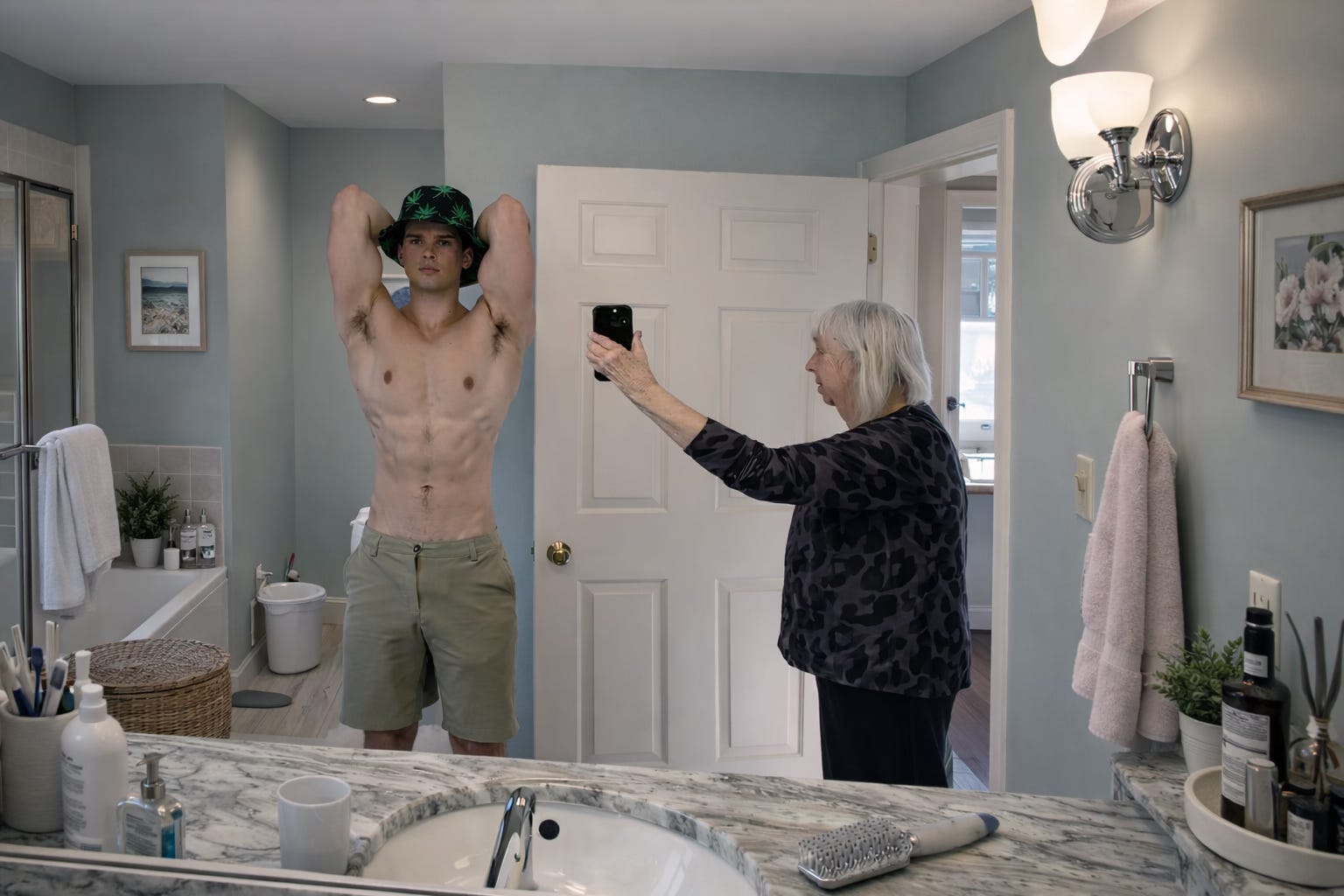
If you haven’t heard of Clavicular, he’s a 20-year-old looksmaxxer who hits himself in the jaw with a hammer to reshape the bone. Films it. Posts it. Millions watch. The practice is called bonesmashing and if you think it’s insane — it is — but spend enough time in that world and you start learning a vocabulary that didn’t exist five years ago.
Mogging. Jestermaxxing. Looksmaxxing. Contentmaxxing. Lookspill. Gooning. I was transcribing Tate to understand his rhythm and now I was cataloguing the slang of boys performing goblin-chad cortisol-spike soap operas for each other in a world where girls don’t seem interested in them and their parents have given up and a single moment on camera can change everything.
These words are ALIVE : forged in the furnace of actual use by millions of people who needed vocabulary the existing language couldn’t give them.
Shakespeare invented 1,700 words for the same reason. Eyeball. Assassination. Lonely. Swagger. The language had to be EXPANDED to fit the reality. Shakespeare mogged Marlowe, mogged Jonson, mogged every playwright in London because he wrote for the WHOLE ROOM — groundlings AND nobles — dick jokes right next to the greatest poetry in the English language because he understood the first job / the ONLY job / is to hold the room, not to be correct, not to be refined, to HOLD THE ROOM.
Who are WE holding? Who is our groundling? Who’s our noble? When we publish on Substack who the FUCK are we talking to?
And why is a 20-year-old who hits himself in the jaw with a hammer doing more for the English language than every MFA program in the country combined?
❧
THE ARENA
I know what you're thinking because I'm thinking it too — “quality matters” and “the long arc of culture” and “keep writing and the work will find its audience” — I’ve heard it all, it’s the bedtime story writers tell themselves so they can keep going and it’s TRUE, it’s all true, but it doesn’t LAND in the arena where the fight is actually happening ; it’s a beautiful argument delivered to an empty room ; it’s foppery in a burning building.
I’m trying to sort this out in real time.
My essay about art got five hundred likes and a hundred and fifty comments and the most-liked comment was a guy telling me I was WRONG and the second most-liked was a guy telling the first guy HE was wrong and the actual essay was just the terrain the fight happened on. They were using my sentences as ammunition in a war I'd accidentally started about whether or not the right had culture and my beautiful paragraphs were just the mud they were wrestling in.
And the WRESTLING was what people came back for.
And that should depress me but it doesn't. It THRILLS me. Because the wrestling means the essay was alive enough to get wrestled over — alive enough to make a country musician and a fascist care about the same sentences for opposite reasons. The problem isn't that my essay became a battlefield. The problem is that most essays will never be vital enough to become one.
And then I scroll the rest of Substack where the literary world is off serializing a melancholy autofiction about a man who journals through his divorce and discovers himself through sourdough, pen name, anon profile picture, no identity, no message, no likes, writing for WRITERS — baseborn heirs to a tradition they won’t fight for.
Somewhere along the way we decided that energy was beneath us. That reaching people was vulgar. That the work should speak for itself, quietly, in a room where nobody can hear it. This is the problem with writers. We have the sagacity and we have the craft and we have nothing : NOTHING : that the feed can smell.
The whole dollop of language they slap on the back of every novel — the “luminous,” the “tender,” the “quietly devastating” — DEAD, dead on arrival, Tate would call it peasant talk, he’d be wrong about why but right about the ENERGY ; and energy is the only currency that moves in the feed, energy is the only thing the algorithm can smell.
❧
JAWS
Now here’s the thing that’s been eating me alive. I’ve got three jaws I can’t stop thinking about.
Cervantes, broke, one arm, rotting in a prison cell, wrote the greatest novel ever written about a man of action, a man who got on a broken horse and rode into a world that beat him senseless because staying in the library was DEATH — the library was where Alonso Quijano sat quietly being nobody and the road was where Don Quixote became immortal. And the word Quixote comes from QUIJADA : — jaw.
Greatest character in Western literature named after a bone.
Same bone Clavicular smashes with a hammer for content. Same bone Tate runs all day without ever letting a book shut it. Three jaws : Quixote’s broken by the world because he believed in BOOKS ; Tate’s never stops moving because he’s SELLING ; Clavicular’s broken by his own hand because he believes in NOTHING.
Quixote got mogged by windmills, mogged by sheep, mogged by barbers and innkeepers and puppet shows, biggest braggart idiot in all of Spain, looked like a fool, looked like a lunatic, lost every fight he ever picked — BUT he kept going. Not because he was smart. Because he was a man of action on a broken horse who believed the world deserved better than what it was giving and he put his body in the way of everything that disagreed.
Tate would love him. Tate would LOVE Don Quixote… a man of action! A man who doesn’t sit around reading! Except that’s exactly what made him. It was the reading that put him on the horse, it was the books that gave him the vision, and when they cured his madness at the end, when Alonso Quijano came back and abjured the romances of chivalry and became sane again — he died.
Sanity killed him.
The reading made him ride.
The riding made him immortal.
The sanity made him nobody again.
So what the fuck do we do with that‽
❧
JJJJJJJJJJJJJJJJJJJJJJJJJJJJJJJJJJJJJJJJJJJJJJJJJJJJJJJJJ
I declared at the beginning of this essay that I felt like Joyce Carol Oates. Think about that. I published one essay and the first name that came to mind wasn’t some young writer in the arena ; it was a venerable 86-year-old woman. That’s how badly we’re cooked. The most vital literary presence on the internet is someone who was publishing novels before my parents were born. There is no one between her and the feedrot.
There is no writer under 60 that any of us reflexively reach for when we want to describe what it feels like to be ALIVE on a platform.
That’s the saddest sentence in this essay and it’s the reason I’m writing it.
I’ve spent two thousand words diagnosing the problem. Diagnosis is what writers are good at : we can dissect a cultural moment with the precision of a surgeon and then do absolutely nothing about it. I fell asleep at my desk somewhere around the fifth hour of this and a voice appeared to me in a dream.
“You’re a bitch,” it said.
It was Andrew Tate. He was enormous. He was shirtless. He was standing in what I can only describe as a celestial cigar lounge — marble floors, no walls, just infinite smoke and the faint sound of a Bugatti idling somewhere beyond the firmament.
“You wrote one Substack essay and you think that makes you a WARRIOR? You’re GAY. You should write an essay about how incredibly GAY you are. Workshop it for two weeks. Send it to your little FRIENDS for feedback. Sit in your room polishing your precious sentences while the world BURNS.”
“I—”
"SHUT UP. Listen to me. ☞ You're going to write for people who would rather watch a man hit himself in the JAW with a HAMMER. Don’t dumb it down — hold it UP. Did Shakespeare simplify Hamlet for the groundlings? No, because Shakespeare wasn’t GAY. He gave them a ghost and a sword fight in the first five minutes and then smuggled in the greatest poetry in the English language while they were paying attention. TOP G shit.”
“Energy first, then depth... that’s good”
“NEXT. ☞ You're going to stop pretending your gay little Substack page is a writing desk. It's a STAGE. That comments section under your essay had more electricity than anything you've ever written — a country musician and a fascist going at each other's throats and you're sitting there like a BYSTANDER in your own arena. The platform isn't a delivery mechanism for your work, it's the work's ENVIRONMENT, and if you ignore the environment you DIE in it."
He took a drag from a cigar the size of a plantain.
"You're going to publish before you're ready. I don't workshop my monologues. There's something in the rawness that the world responds to, something your seventh draft will never have, and I'd rather be alive and wrong than DEAD and CORRECT and incredibly GAY."
"Is this a dream or a vision?"
"It's a PROPHECY, bitch. LASTLY. ☞ You're going to tell them who you are. No fake names. No anonymous bullshit. YOU — the actual scribbling PEASANT behind the sentences — because that is the only thing I can't replicate and the only thing anyone will remember. I have a 110 million dollar car collection and nobody remembers a single thing I've SAID — they remember how I made them FEEL. You have SENTENCES. Make them feel something or get the fuck off the stage."
He dissolved into the cigar smoke. The Bugatti revved once and went silent. I woke up at my desk with my face on the keyboard and the letter J seared into my cheek.
❧
PART II
The next morning I made coffee. I unpacked the suitcase I still hadn’t fully opened since landing in LA (the one from the last essay, the one I’d crammed with Cervantes and Céline and Borges and every other magnificent bastard who’d survived the tribunal) and there was the Quixote.
I remembered something about Part II.
In Part II of Don Quixote — published ten years after Part I — Quixote rides out again and discovers that everyone has already read Part I. The barbers know him. The innkeepers have opinions. A Duke and Duchess have read the book and stage elaborate pranks because they think he's hilarious. He's become CONTENT. He's become a meme of himself. Somebody else has even published a fake sequel — a fraudulent Part II by a hack named Avellaneda — and Quixote has to ride through a world where a plagiarized version of himself is already out there, saying things he never said, doing things he never did.
He rides out anyway. Knows they’re laughing. Doesn’t care.
Somewhere between Andrew Tate soliloquies and Clavicular’s bonesmash pageantry I’d written an essay about art and the essay had become content and the content had become a battlefield and now I was writing ABOUT the battlefield which would become content which would become a battlefield and so on.
This is the Quixote Part II problem. You ride out KNOWING. Part I you’re delusional — you think the windmills are giants, you think the essay will change minds, you think the sentences matter on their own. Part II you know they’re windmills. You know the Duke is laughing. You know the comments section is going to devolve into a federal tax dispute between a country musician and a fascist.
You ride out ANYWAY — not because you’re crazy anymore but because the riding is the THING, the riding is the only thing that was ever real, and if you stop riding you become Alonso Quijano again and Alonso Quijano dies in bed like a reasonable man surrounded by people who are relieved he’s—
"PUSSY. You wrote a whole essay about ENERGY and you're ending it with a guy dying in BED like a BROKE person? Get on the horse, BITCH."
I’m trying to—
“Nobody cares about YOUR horse. Tell THEM to get on the horse. You’re a WRITER — you have READERS — what are they doing? They’re sitting there READING while the world BURNS. Forget about your broke ass for one second and tell these people to RIDE.”
You heard the man.
This is not a call to arms it’s a call to LEGS — the horse is broken, the lance is a broomstick, the armor is cardboard — GET ON THE HORSE — get on Substack, get on X, get on TikTok, don’t abjure the arena because it’s vulgar — the Globe smelled like piss, the agora was crawling with yeggs and varlets, every venue where human speech has ever MATTERED was loud and dirty and hostile and the people who changed things showed up anyway.
They mar the feed with hammers? We mar it with sentences that lodge in the skull like shrapnel ; they create words? We create WORLDS ; they have volume? We have DENSITY, and Tate says his intellect far surpasses anything that can be prescribed by the English language on a piece of paper — FINE, but a sentence that rearranges a reader’s cells is worth ten million views of a man saying he’s too smart for reading, and that sentence has to REACH the reader / through enemy territory / on a broken horse / with a dollop of madness.
We’re going to look like idiots. Beautiful idiots.
This was so damn fun to read. And to read again! Thank you!
I agree with your sentiment. If writing presents a form of life, then writing must change its forms when life's forms change. This was the argument that Pound and the Modernists made 100 years ago; however, the analogy with Shakespeare doesn't work for me on this point: Shakespeare did not create his audience, and, more importantly, he HAD an audience. The medium of theatre itself drew diverse crowds because it was immediately accessible. One didn't need to be literate to enjoy it. There was something for everyone in his plays--there was something OF everyone in his plays--because his audience was a cross-section of London society. Writing with energy is desirable and necessary, and writers should embrace the spastic energy of the influencer just as Alfred Kreymborg (I believe) recommended that Moderist writers embrace the language of advertisement. Even so, the problem remains: who will be there to witness as you charge the windmill?